Where Authors Can Pitch: Independent Bookstores and Author Events in the United States

FEATURED FIND BOOKSTORES REPORT · OCTOBER 2026
What 1,093 independent bookstores across all 50 states and the District of Columbia publish about how to reach them and what events they run, based on the records compiled for Featured's Find Bookstores.
Prepared by Featured, October 2026
- 1,093 Independent bookstores tracked (Across all 50 states and the District of Columbia, in 796 cities)
- 61.5% Link to a public events page (Stores whose public website links directly to an events or calendar page)
- 37.5% Describe author events (Stores that describe author events, readings or signings in their own words)
Three in five stores already tell you where their events live
Authors, publicists and publishers spend a great deal of effort assembling lists of bookstores to pitch for readings, signings and talks. Most of that effort goes into answering two questions store by store: can this shop be reached, and does it actually host events? Featured compiled 1,093 independent bookstores for its Find Bookstores capability, recording each store's public website, contact channel and a short description of its programming.
The headline is that the independent bookstore channel is more open than it may appear. A majority of stores link directly to a public events or calendar page, more than a third publish an email address, and taken together 74.7% of stores offer at least one of those two direct routes in. Programming is widespread but uneven: well over a third of stores describe author events in their own words, while book clubs, storytimes and local-author programs are each run by a smaller, more specialized group. Geographically, the stores concentrate in a handful of coastal states and a few dense cities, yet most cities in the database have exactly one listed store.
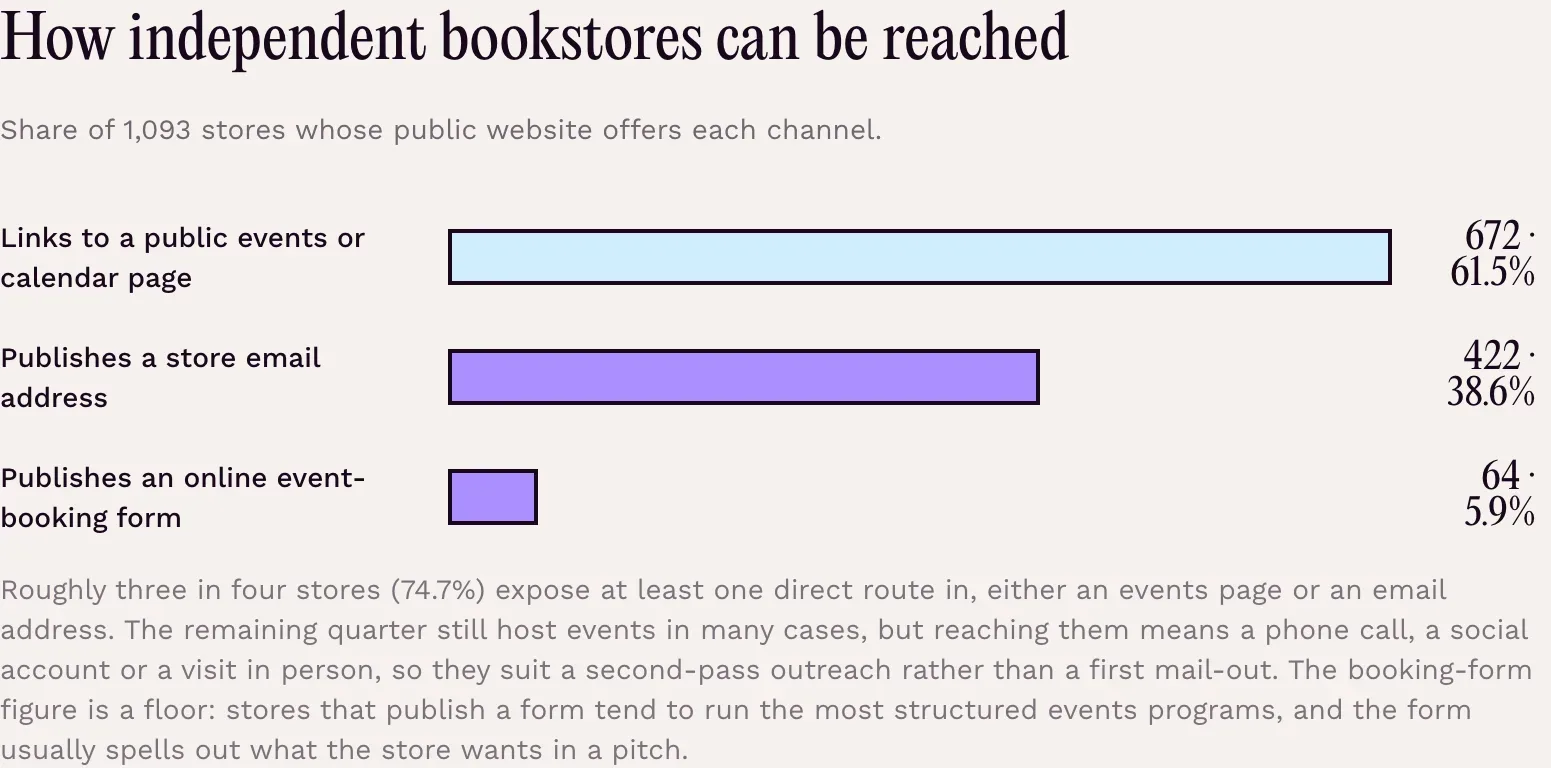
Most stores publish a route in, but few publish a form
The first hurdle in pitching a bookstore is finding the right door. 61.5% of stores (672) link directly to a public events or calendar page, the clearest signal a store sends about its willingness to host: it shows the cadence of events, the kinds of authors who appear and, often, who to contact. A further 38.6% of stores (422) publish a general email address for the store, which remains the most common way to make a first approach. Only 5.9% of stores (64) have gone as far as publishing an online form for booking or requesting an event, so for the overwhelming majority the pitch still arrives by email or through an events coordinator named on the calendar page.
Author events are common; specialized programs are not
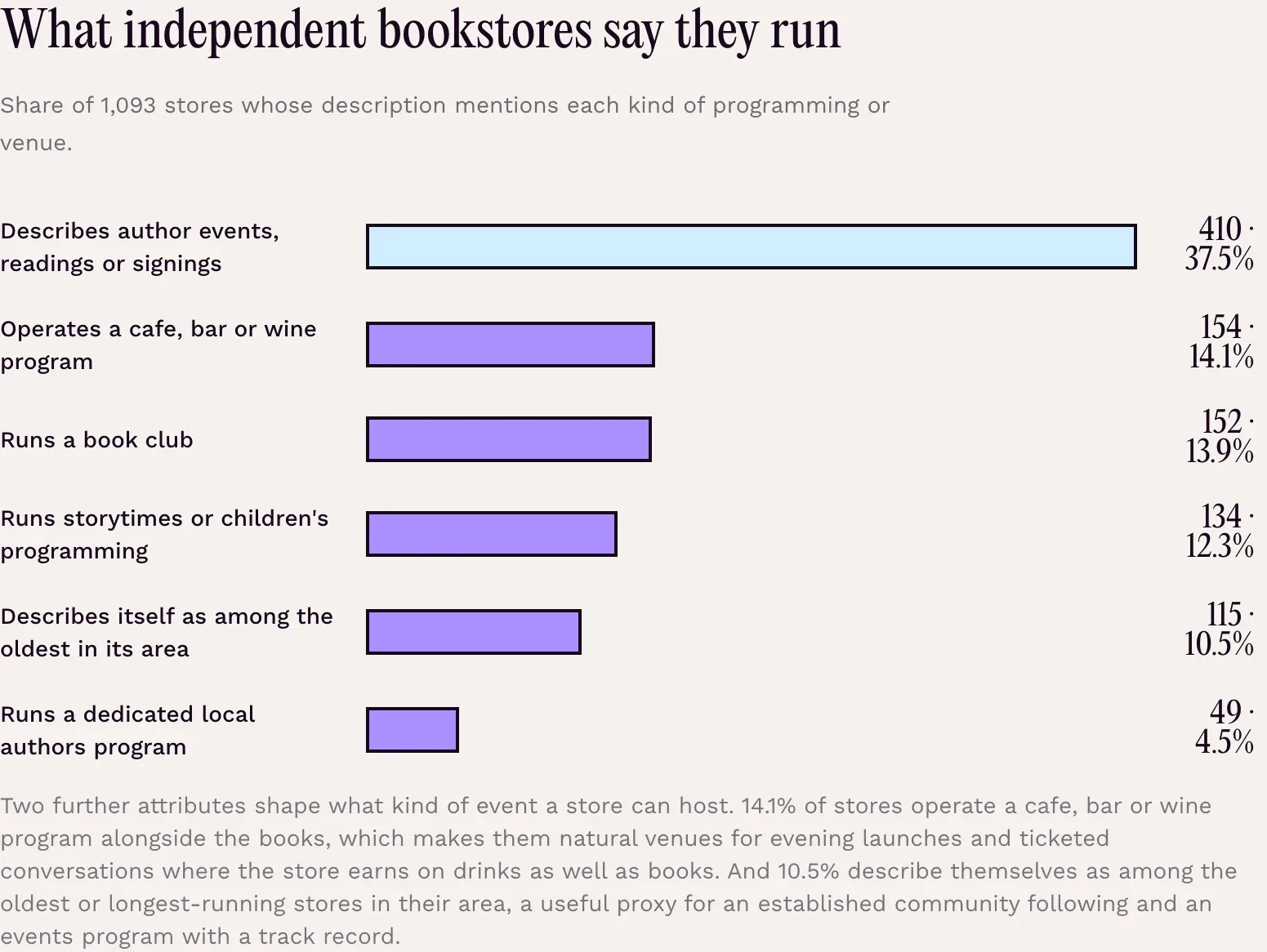
Each store's description was written from its own public materials, so the programming measures reflect what stores say about themselves rather than an outside judgment. On that basis, 37.5% of stores (410) describe author events, readings or signings. That is the core audience for any author pitch, and it is large enough that a national campaign can be selective about fit rather than sending to everyone.
The more specialized programs are run by a much smaller group. 13.9% of stores run a book club, which matters for backlist and paperback campaigns where a club adoption can produce a sustained run of sales. 12.3% run storytimes or children's programming, the natural venue for picture-book and middle-grade authors. Just 4.5% of stores (49) describe a dedicated local authors program, a formal pathway for writers from the surrounding area that often includes consignment terms and a recurring showcase event.
Five states hold a third of the stores; most cities hold one
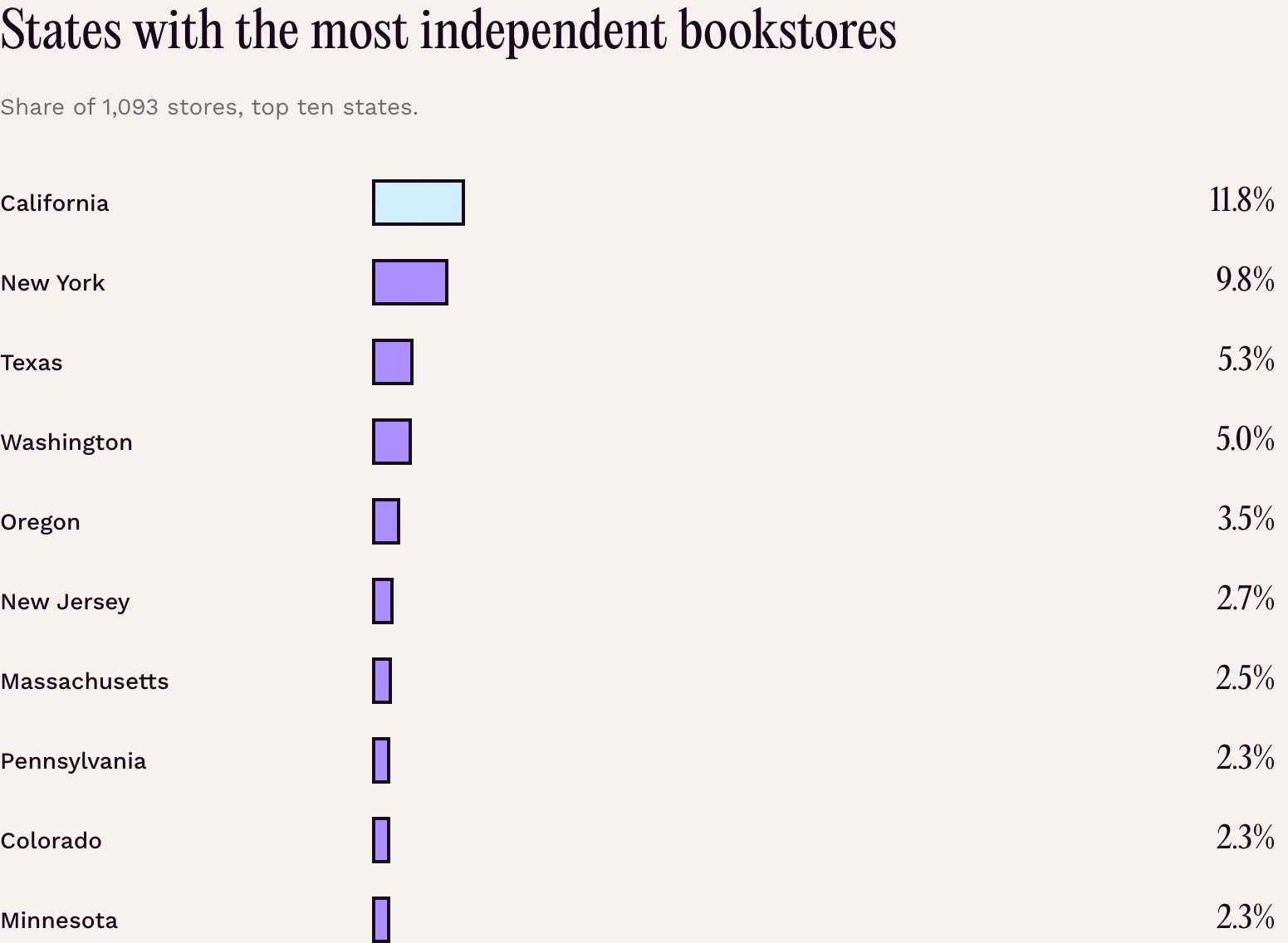
The database spans all 50 states and the District of Columbia, but the distribution is steep. California (11.8%), New York (9.8%), Texas (5.3%), Washington (5.0%) and Oregon (3.5%) have the most stores, and together those five states account for 35.4% of the total. The West Coast and the Northeast are the center of gravity, with Texas the only large interior market in the top five.
Densest cities
Brooklyn and New York City are the densest markets, followed by San Francisco and Seattle. These are the places where an author can string several events into a single trip.
| City | Listed stores |
|---|---|
| Brooklyn, NY | 23 |
| New York, NY | 22 |
| San Francisco, CA | 15 |
| Seattle, WA | 15 |
| Washington, DC | 12 |
| Portland, OR | 11 |
| Chicago, IL | 11 |
| Minneapolis, MN | 9 |
| Los Angeles, CA | 8 |
| Dallas, TX | 7 |
The more striking pattern runs the other way. Of the 796 cities in the database, 666 have exactly one listed store, 109 have two to four, and only 21 have five or more. For most of the country the independent bookstore is a singular local institution rather than one option among several, which cuts two ways for outreach: there is rarely a substitute venue if the first pitch fails, but a one-store town's shop is often the only literary event space for miles and commands a loyal audience that big-city stores have to compete for.
Building a bookstore pitch list from these findings
Start with the stores that describe author events. The 37.5% of stores that describe readings and signings in their own words are already running the kind of event an author is asking for. Among them, 15.0% of all stores both describe author events and publish an email address: a known program and a published way to reach it, which makes them the most efficient first wave.
Use the events page before you write. With 61.5% of stores linking to a public calendar, there is rarely a reason to pitch blind. The calendar shows whether a store favors ticketed conversations, free in-store signings, offsite partnerships or children's programming, and it often names the events coordinator.
Match the format to the venue. The 14.1% of stores with a cafe, bar or wine program are the natural homes for evening launches. Book-club stores (13.9%) are the right targets for paperback and backlist campaigns. Stores with storytimes (12.3%) are where children's authors should concentrate. The 4.5% with a dedicated local authors program are worth approaching through that program rather than the general events inbox.
Plan tours around density, but do not skip the one-store towns. Brooklyn, New York, San Francisco, Seattle, Washington, Portland and Chicago allow several events in one trip, and the five largest states hold a third of all stores. But 666 of 796 cities have a single listed store, and those stores often command the most committed local audiences. A tour that pairs one dense city with two or three one-store towns along the route tends to reach more readers per mile than one that stays in the metros.
Treat the booking form as the preferred path when it exists. Only 5.9% of stores publish an event-request form, but where one exists it is the path the store has chosen, and submitting through it usually moves faster than an email that has to be forwarded to the right person.